BESS Arbitrage in the uk
The United Kingdom faces some of the most expensive and volatile electricity tariffs globally, driven by volatile gas prices, network constraints, and renewable intermittency. For residential energy consumers, deploying behind-the-meter domestic batteries offers a theoretical shield against this volatility. The challenge of this self-identified project was to quantitatively identifying the exact macroeconomic drivers of these tariffs and designing a dynamic dispatch algorithm to maximize the profitability of buying, storing, and selling electricity in real-time.
The Approach: Data Science, OLS Regression, & Algorithmic Dispatch
This project used advanced data analytics and control system engineering to simulate real-world grid interactions.
Macro-Tariff Analysis: Coded an Ordinary Least Squares (OLS) regression model to multi-year grid datasets. Evaluated the specific impact of variables like regional demand, gas prices, and renewable generation on half-hourly electricity tariffs.
Algorithmic Value-Stacking: Developed a sophisticated Model Predictive Control (MPC) algorithm designed to autonomously manage battery state-of-charge (SOC).
Dynamic Dispatch Simulation: Programmed the MPC to execute complex "value-stacking" strategies over annual, standardised operational profiles. The model successfully charged during overnight price troughs, discharged to during evening demand price peaks, and capitalized on times of high-value grid exports.
The Outcome: Commercial Viability & Regional Strategy
The analysis successfully bridged the gap between data science and energy transition economics. There is significant potential for energy savings on the residential level with an in-house BESS.
Isolated Price Drivers: Proved that natural gas prices and peak demand—rather than renewable generation intermittency—are the primary drivers of UK regional tariffs, underlining the necessity of demand-side response andflexibility.
Targeting Profitability: Processed regional tariff variations to identify London, the East Midlands, and Eastern England as the most financially lucrative regions for battery deployment.
Quantified Net Savings: Demonstrated that an optimized, algorithmically controlled domestic battery system can successfully utilize peak-shaving and arbitrage to generate sustained, cumulative net savings for consumers, accelerating the payback period of energy storage assets.
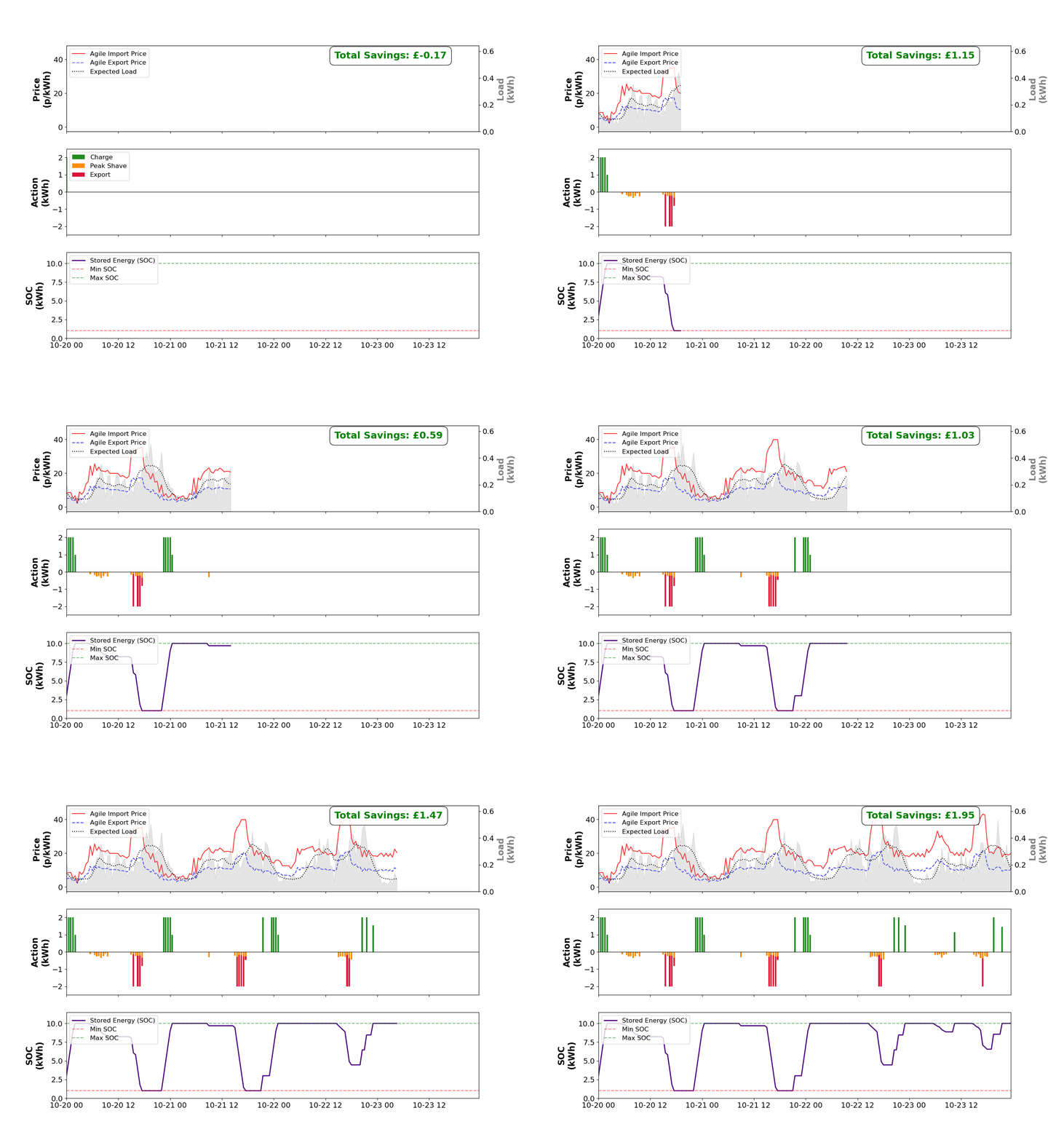
A visual representation of what the code for this project was doing. During peak evening hours when demand and electricity prices were high, the battery released stored electricity to the simulated household to avoid the higher prices. At night when demand and prices are low, the battery recharges cheaply. The algorithm accounts for the degradation cost of the battery, meaning it only charges and discharges at an absolute profit
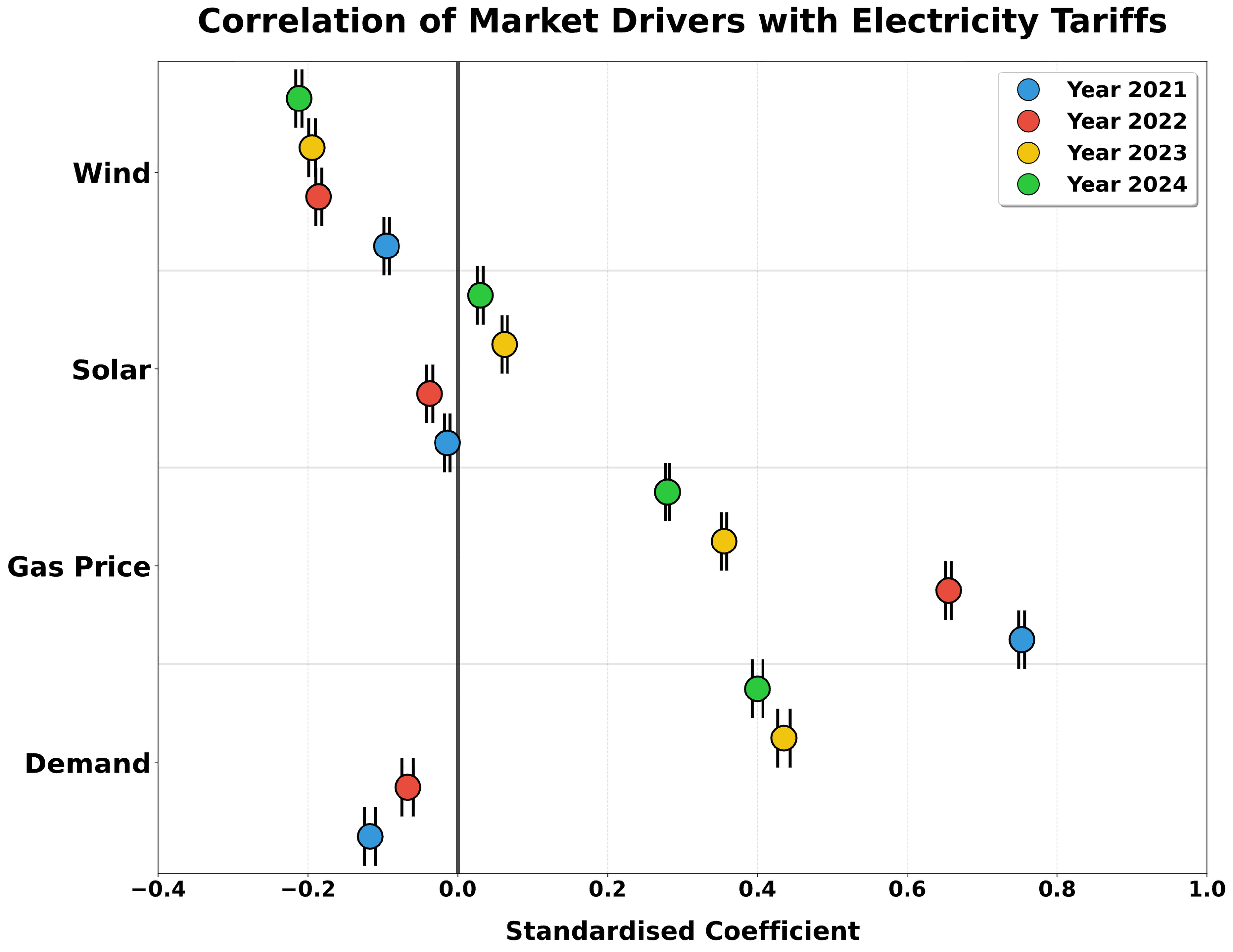
During times of abnormal gas prices (2021-22 due to Russia’s invasion of Ukraine), gas prices were strongly correlated with electricty prices. High wind production has steadily increased in correlation with lower electricity prices over the past 4 years, aligning with higher wind production. Solar showed no correlation while demand only showed correlation during years when gas did not dominate, meaning during a “normal” period of gas prices, demand is the main driver of electricity price.
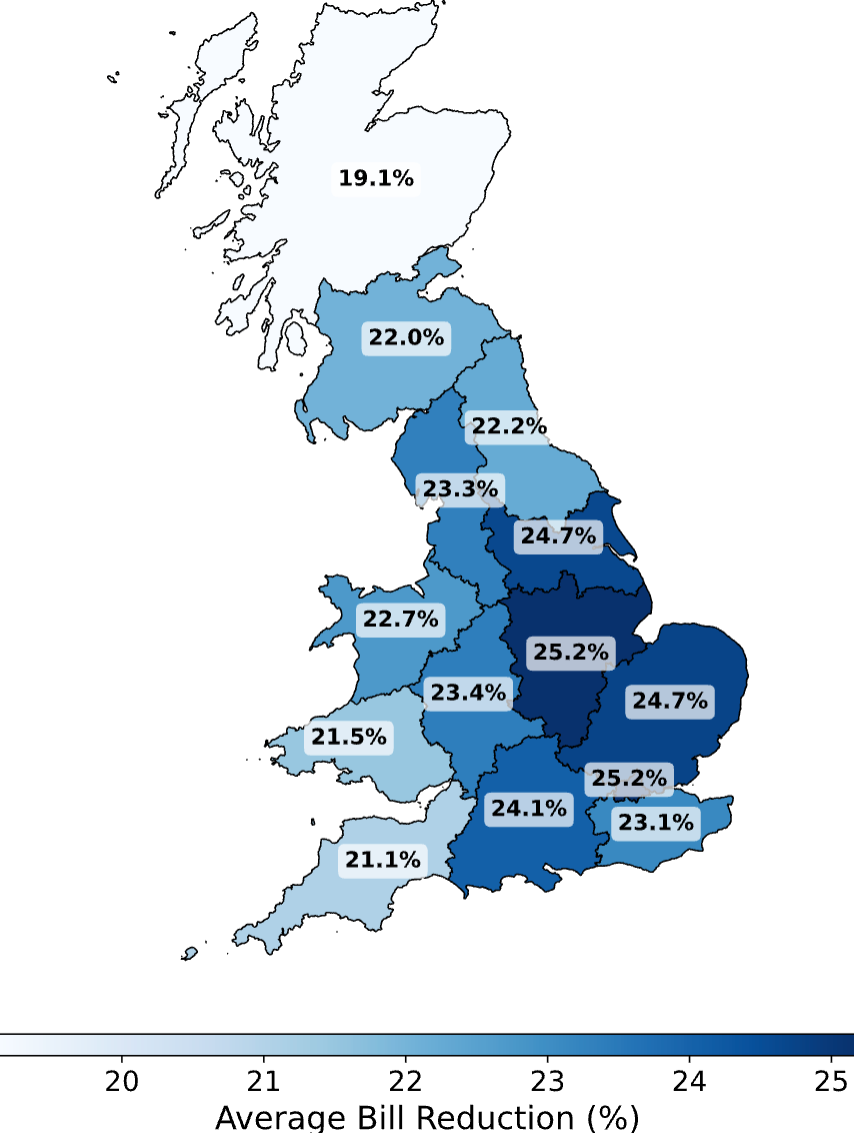
Heat map of most annual electricity bill savings (%) by region. All regions are between 19-26%, a significant reduction and attractive payback period (6-8 years) which is shorter than battery lifetime (>10 years).