energy efficiency retrofits for 19th century school buildings
The Problem: Legacy Infrastructure & Thermal Inefficiency
Decarbonizing the built environment is one of the most significant challenges in the energy transition. The Greenway Institute’s 38,000 sq. ft. Dewey Hall was crippled by a 1960s-era oversized steam boiler system that burned up to 25,000 gallons of fuel oil annually. The system has no zonal control, causing extreme overheating, with massive thermal losses through uninsulated brick walls and single-pane windows. The objective was to build a roadmap to eliminate the building's fossil fuel dependency, increase the efficiency of the building, and engineer a modern, zero-emission heating system while financially justifying the capital expenditure with a full techno-economic analysis.


The Outcome: Techno-Economic Feasibility & Payback Modeling The project culminated in a rigorous financial analysis, proving how different policy incentives can dictate the viability of large-scale infrastructure decarbonization.
CAPEX vs. OPEX Modeling: Compared the massive operational fuel costs of the legacy oil system against the $3.1M capital expenditure required for the GSHP borehole drilling and hydronic conversion to determine payback period and long term opperational cost differences.
Incentive Integration: Modeled the project's lifecycle payback period under many financing scenarios. Demonstrated that while the baseline break-even point was 41.2 years, the strategic layering of 30% federal tax credits, DOE grants, and structured loans reduced the payback period to 24.2 years.
Scalable Blueprint: Provided the institute with a data-driven plan to eliminate massive fuel oil expenditures and align their physical infrastructure with their institutional sustainability mission.
The Approach: Heat-Loss Modeling & Phased Deployment
To transition the facility from high-pressure steam to a low-temperature water system, the project required a full thermal and economic baseline analysis.
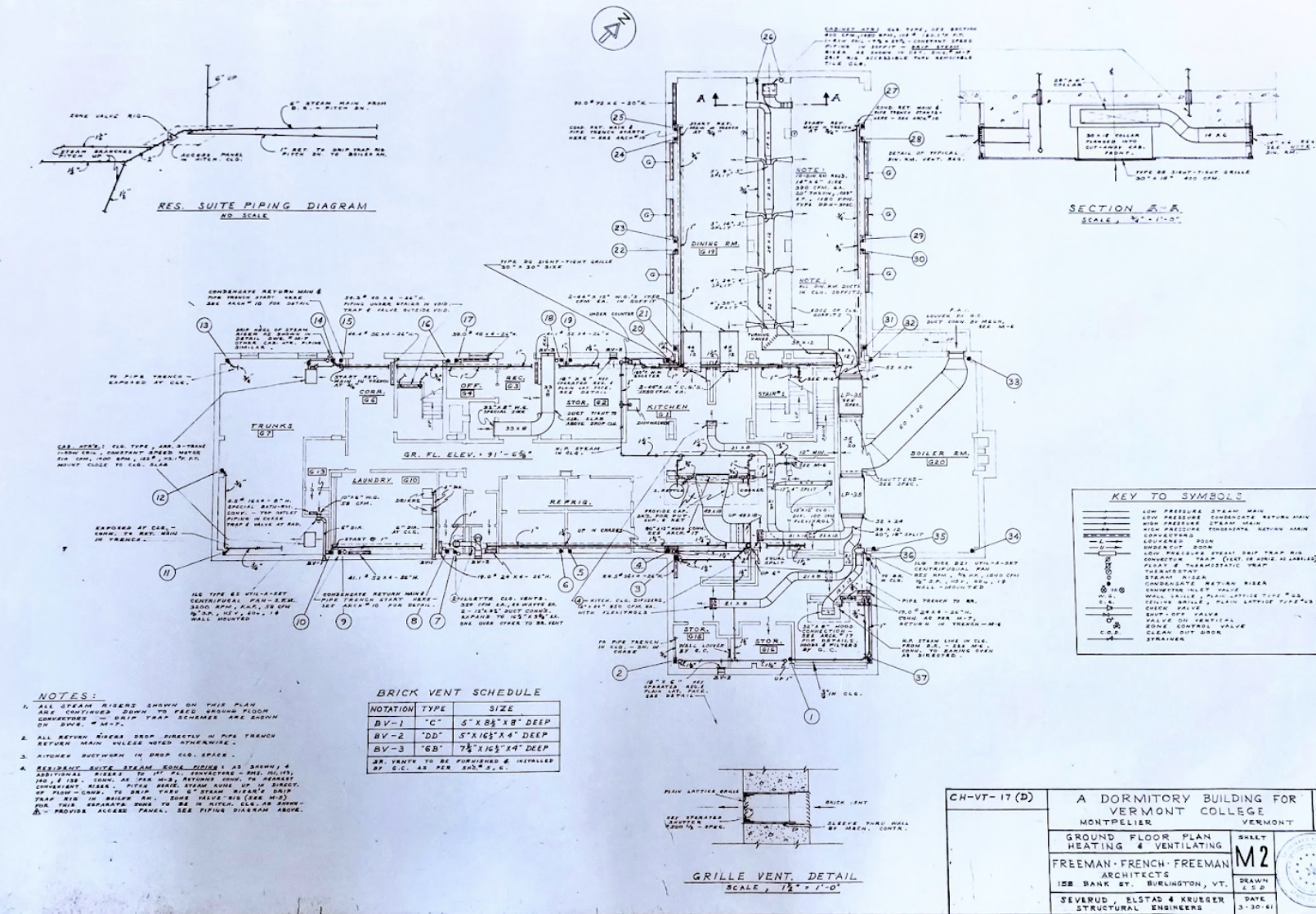
Thermodynamic Envelope Analysis: Extracted architectural blueprints to conduct a room-by-room heat loss analysis. Calculated precise BTU/hr load requirements based on infiltration rates, window U-values, and exterior wall surface areas, proving the existing 2.36M BTU/hr boiler was operating at nearly double the required capacity.
Phase 1 (Efficiency Retrofits): Modeled the energy savings and dollar-per-hour impact of easier envelope upgrades, including large-scale window replacements, loose-fill attic insulation, and thermostat adjustments.
Phase 2 (Renewable Integration): Designed a complete mechanical replacement of the legacy oil-steam system with a high-efficiency Ground Source Heat Pump (GSHP). Postioned the building’s distribution network from steam to a modern hydronic (hot water) heating and cooling system better sized for a 1.2M BTUH peak load.
| Retrofit Measure | Initial Cost (USD) | Est. Savings ($/hr) | Payback Period |
|---|---|---|---|
| Phase 1: Efficiency Retrofits | |||
| Lower Thermostat (5°) | $0 | $1.37 | Immediate |
| Zonal Heating (by floor) | $5,000 | N/A | — |
| Attic Insulation | $49,000 | $3.71 | 4.5 years |
| Window Replacement | $110,000 | $2.31 | 16 years |
| Phase 2: Renewable Integration | |||
| Ground Source Heat Pump (GSHP) | $3,099,250 | $20—50 | 24–41 years |