powering scottish distilleries with green hydrogen
The Problem: The Cost and Carbon of Off-Grid Industry Heavy industries located in remote, off-gas-grid locations are entirely dependent on delivered fossil fuels. The Isle of Raasay Distillery consumed 1.77 GWh of kerosene annually to fire its distillation boilers, generating massive carbon emissions (529 tCO₂e) while exposing the business to extreme fuel price volatility. The challenge was to engineer a zero-emission alternative fuel supply chain that was not only logistically viable for a remote island but also financially structured to eliminate the massive upfront capital expenditure (CAPEX) that typically kills decarbonization projects.
The Outcome: Bankable Infrastructure & Macro-Scalability The resulting business plan delivered a highly profitable framework that successfully balanced the distillery's need for cheap heat with the infrastructure developer's need for high returns.
Emissions Elimination: The integration of a direct-flame hydrogen boiler achieved a 95% reduction in total facility emissions (dropping from 461 to just 21 tCO₂e/yr) without requiring any changes to the core distilling process.
Developer Returns: The financial model proved highly lucrative for the infrastructure provider, generating a Net Present Value (NPV) of £350K, a 14.2% Internal Rate of Return (IRR), and a rapid 7-year payback period.
Macro-Scale Thresholds: Modeled the expansion of this supply chain across Scotland. Mathematically proved the exact infrastructure "tipping point," demonstrating that capital-intensive permanent hydrogen pipelines become economically superior to truck delivery once the network scales to serve 67 distilleries.
The Approach: End-to-End Value Chain & EaaS Modeling To solve this, the project required designing a complete "Wind-to-Whisky" green hydrogen infrastructure pipeline, backed by a rigorous techno-economic commercial model.
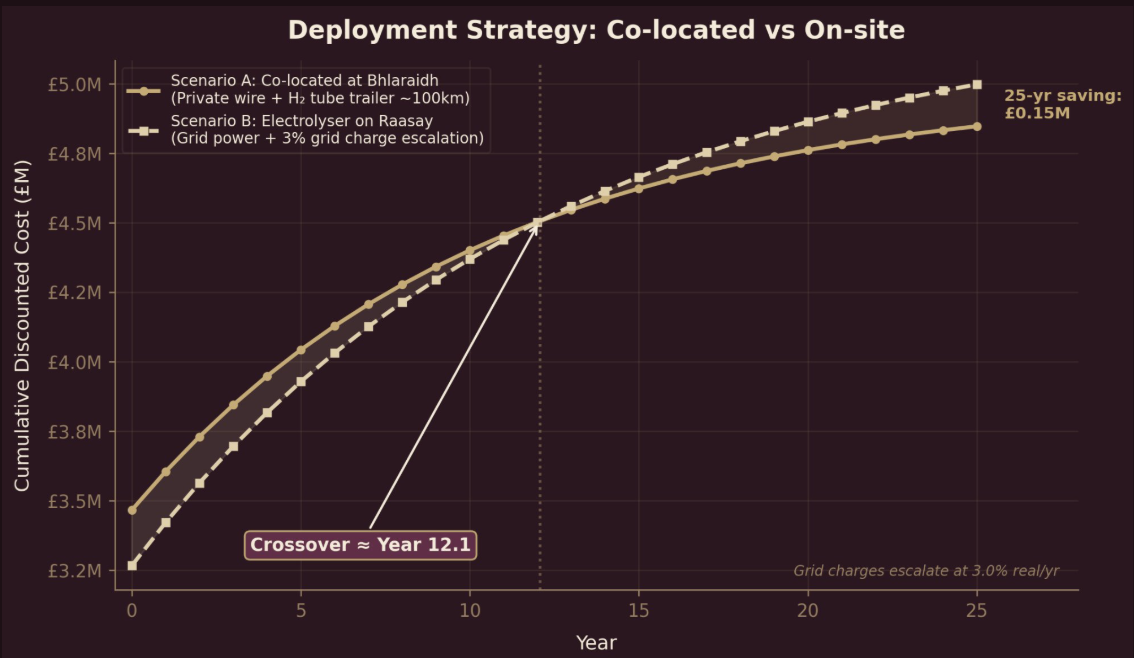
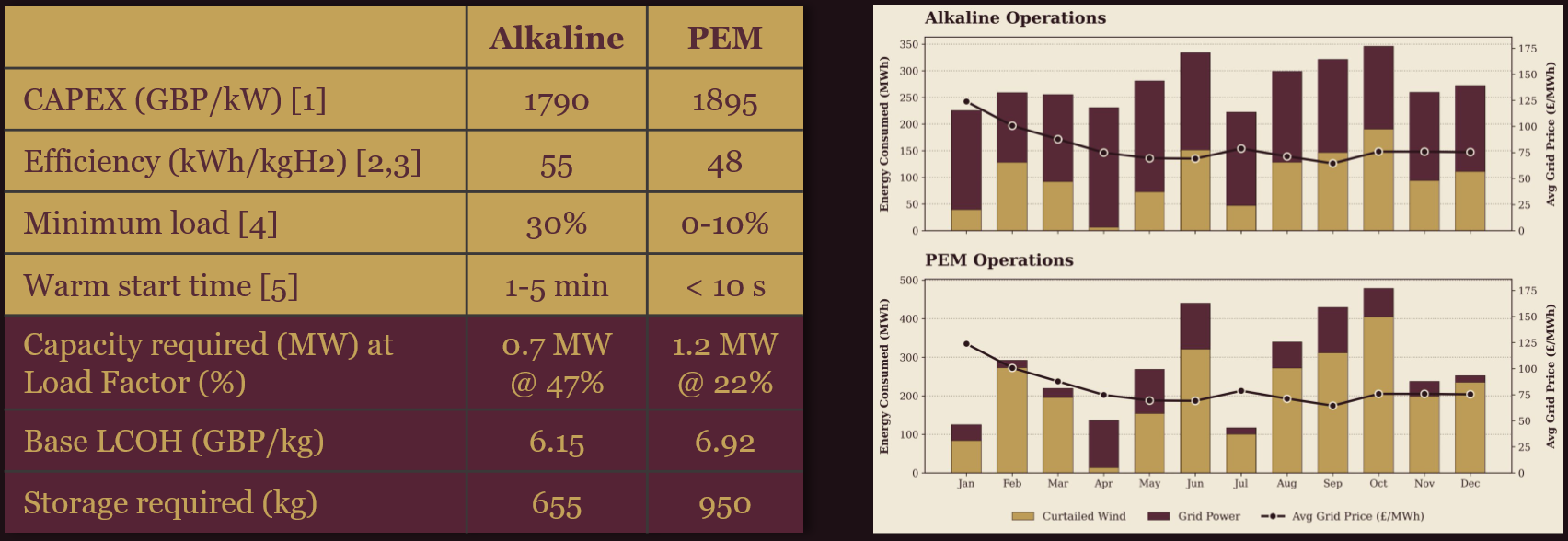
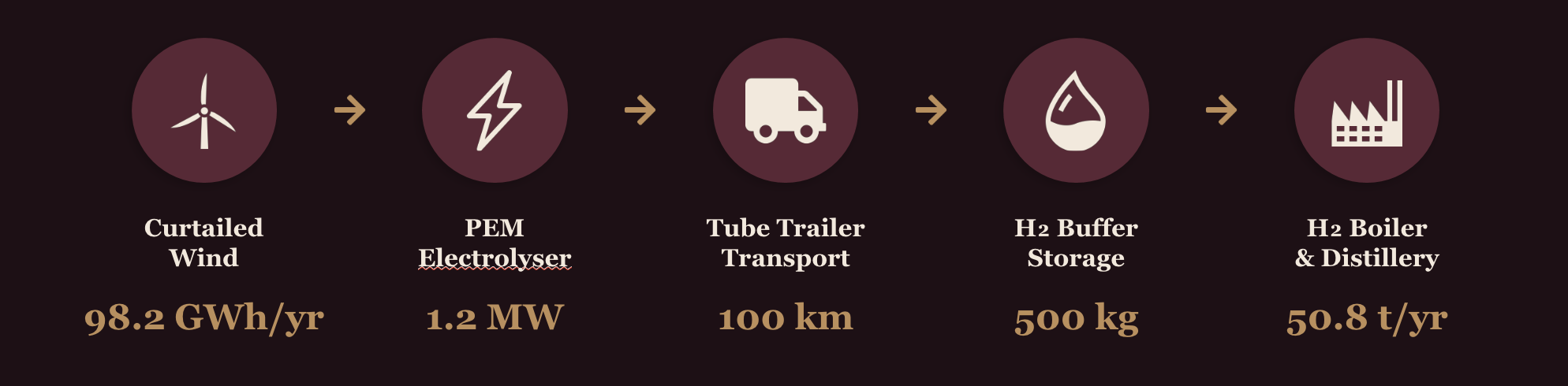
Production & Sourcing: Designed a system to capture curtailed wind generation from the mainland Bhlaraidh Wind Farm to power a 1.2 MW PEM electrolyser, effectively turning wasted renewable energy into high-density fuel.
Logistics & Island Resilience: Engineered a compressed-gas tube trailer transport route (100km) paired with a 500 kg (350 bar) on-site buffer storage system. This specific storage capacity was calculated to guarantee 3.6 days of supply autonomy, a critical requirement to protect the island facility from ferry disruptions or severe weather.
The EaaS Financial Structure: Developed an Energy-as-a-Service (EaaS) commercial model. By strategically layering £700k in modeled government grants (Net-Zero Hydrogen Fund), the project absorbs the infrastructure CAPEX, allowing the distillery to simply pay for the delivered hydrogen at a highly stable Levelized Cost of Hydrogen (LCOH) of £7.8/kg.