Decarbonizing the port of LA
The Problem: Policy Bottlenecks in Global Supply Chains The Port of Los Angeles (POLA), the largest container port in the US, was critically off-track to meet its 2030 and 2050 emission reduction targets. Existing policies, such as a flat $10/TEU Clean Truck Fund (CTF) fee, failed to financially incentivize the transition away from diesel Heavy-Duty Vehicles (HDVs). Furthermore, ocean-going vessels were burning massive amounts of fuel while idling at anchor due to inefficient "rush-to-wait" arrival patterns, and deep-sea transit remained entirely reliant on fossil fuels. The challenge was to engineer a holistic, multi-tiered commercial strategy to decarbonize landside, portside, and seaside operations without disrupting trans-Pacific trade.
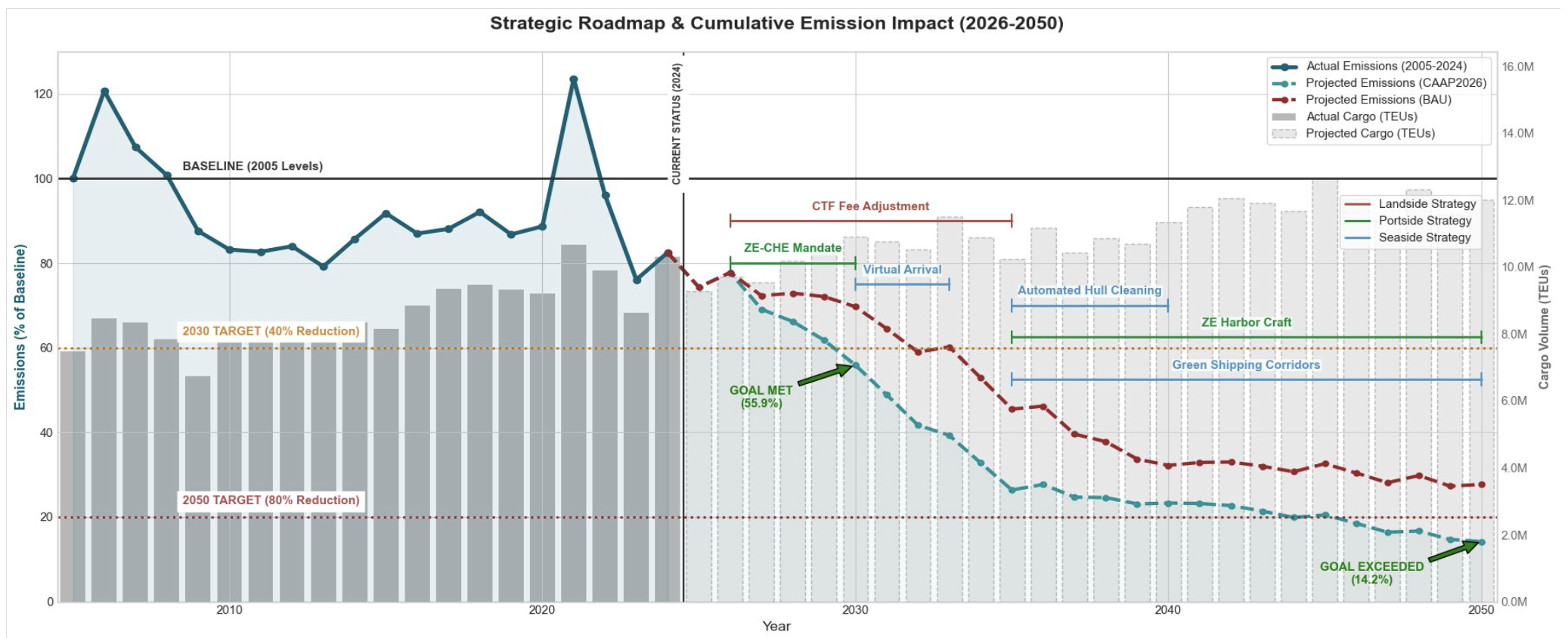
The Outcome: A Bankable Path to 85% Emissions Reduction
The analysis delivered a data-driven blueprint for port authorities and infrastructure developers, proving the financial feasibility of large-scale decarbonization.
Immediate Logistical Savings: The "Virtual Arrival" model proved capable of cutting approximately 4,500 tonnes of $CO_2e$ per month with minimal upfront capital expenditure.
E-Methanol Commercial Viability: Conducted a rigorous techno-economic assessment of the SMR power-to-fuel facility. Modeled the Levelized Cost of Methanol (LCOM) dropping from $1,230/t (First-of-a-Kind) down to a highly competitive $490/t (Nth-of-a-Kind) as technology matures, bringing it to parity with conventional marine fuels.
System-Level Impact: The combined, phased deployment of these strategies successfully realigned the port's trajectory, projecting a 44% overall emission reduction by 2030 and an 85% reduction by 2050.
The Approach: Financial Modeling, Logistics, & Nuclear Integration To bridge the gap between environmental policy and commercial reality, the project utilized advanced modeling to restructure port tariffs, optimize vessel logistics, and design a zero-carbon fuel supply chain.
Dynamic Tariff Modeling (Landside): Proved that the existing flat-rate CTF fee was financially inadequate. Modeled aggressive alternative fee schedules (Linear and CAGR), demonstrating that an escalating tariff would force Total Cost of Ownership (TCO) parity in favor of EVs by 2035, while generating over $2.8 Billion to subsidize truck procurement and critical 34.5-kV grid upgrades.
Algorithmic 'Virtual Arrival' (Seaside): Developed a simulated arrival model to eliminate anchorage idling. By optimizing vessel approach speeds to a 6-knot safety floor within a 500 nm zone, the model converted wasted idle time into fuel-efficient slow steaming.
SMR-Powered Green Corridor (Deep Tech): Designed an end-to-end e-methanol production facility powered by a 150 MW Kairos Small Modular Reactor (SMR). Integrated PEM electrolysis, Liquid Direct Air Capture (L-DAC), and Plasma Reverse Water-Gas Shift (RWGS) processes to synthesize zero-carbon fuel for a dedicated LA-to-Shanghai shipping corridor.