planning and designing a wind farm
The Problem: Balancing Aerodynamic Yield with Commercial Viability Developing utility-scale wind infrastructure requires navigating a complex web of environmental constraints, aerodynamic losses, and tightening profit margins. The objective was to design a fully optimized onshore wind farm in the UK (Manston region) from the ground up. The challenge lay in isolating a legally and geographically viable site, modeling turbulent wind regimes to minimize wake losses, and determining the exact turbine configuration that would maximize financial returns rather than just sheer energy output.
The Outcome: A Highly Profitable, 30 MW Infrastructure Asset The analysis successfully proved the commercial reality of wind development: the configuration with the highest energy yield is not always the most financially viable investment.
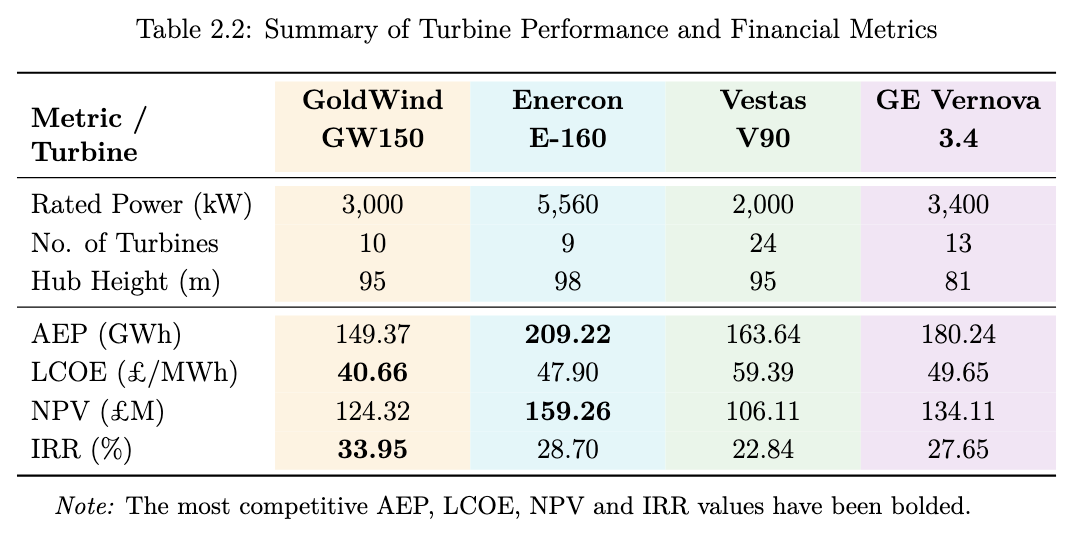
Strategic Configuration: Selected an array of ten GoldWind GW150 (3 MW) turbines at a lower 95-meter hub height, deliberately sacrificing marginal top-end energy generation to drastically reduce structural and installation CAPEX.
Robust Financial Returns: Delivered a highly profitable commercial blueprint generating 148.8 GWh/year with a projected Net Present Value (NPV) of £124.3 Million, an Internal Rate of Return (IRR) of 34%, and a rapid 5-year capital payback period.
Lifecycle Strategy: Future-proofed the asset by outlining a partial re-powering End-of-Life (EoL) strategy, retaining foundation infrastructure to extend the project's lifespan by 15-20 years while maintaining high operational margins.
The Approach: Resource Modeling & Layout Optimization
To transition from raw geographic data to a fully costed infrastructure project, the analysis combined aerodynamic modeling with rigorous project finance evaluations.
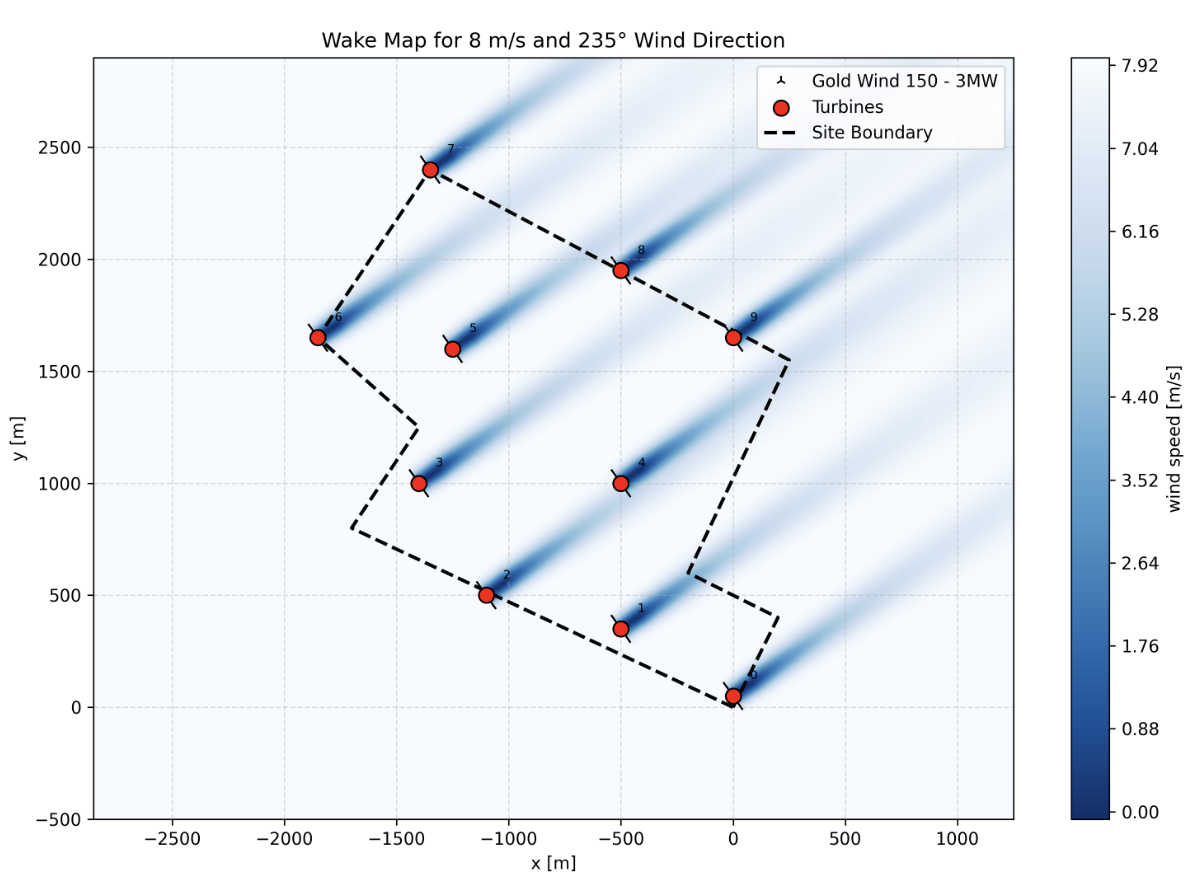
Geospatial & Resource Mapping: Executed an exclusionary mapping process to bypass restricted airspace, protected nature reserves, and residential zones. Modeled the site's wind regime using a 36-sector Weibull distribution to capture direction-dependent wind speeds and accurately pinpoint the prevailing south-westerly ($235^{\circ}$) energy potential.
Wake Mitigation & Layout Design: Utilized PyWake and TopFarm algorithms to iteratively optimize the spatial arrangement of the turbines. Engineered a staggered layout specifically aligned with the prevailing wind vector to minimize downstream turbulent wake losses and maximize aerodynamic efficiency.
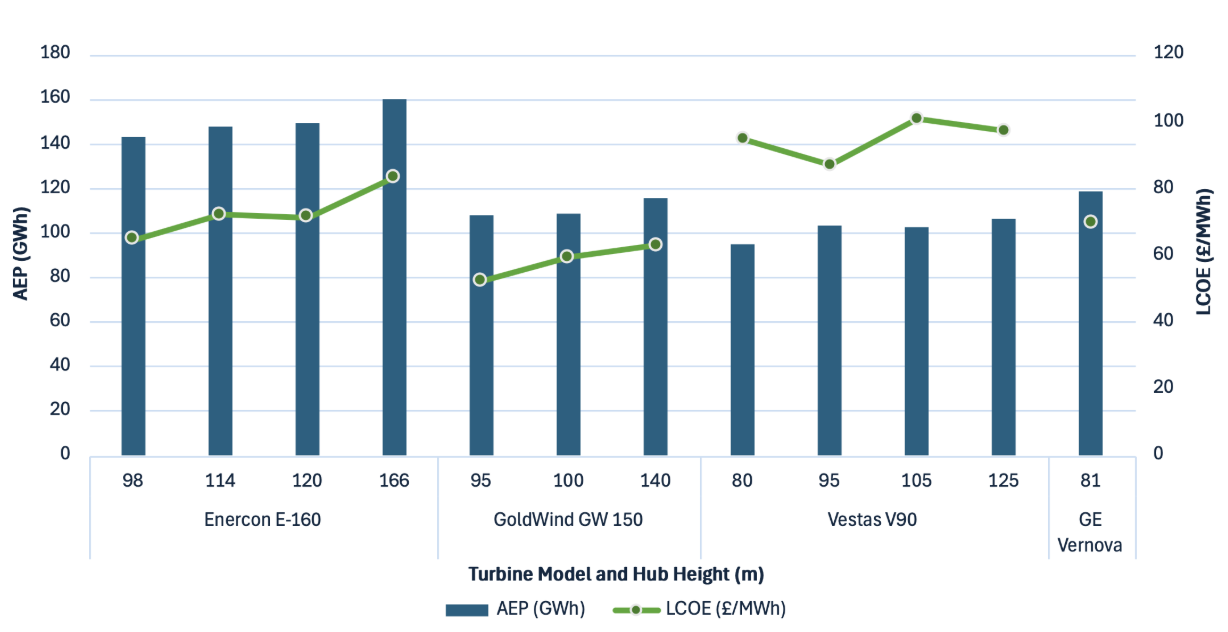
Financial Sensitivity Analysis: Modeled CAPEX, OPEX, and Levelized Cost of Electricity (LCOE) across four different commercial turbine models (Vestas, Enercon, GoldWind, GE Vernova) at varying hub heights. Evaluated the non-linear cost increases of taller towers against their marginal gains in Annual Energy Production (AEP).